Flanker
About Flanker
This game is derived from a well-known cognitive assessment test used in psychology
and neuroscience to measure cognitive control, specifically the ability to suppress
irrelevant information and focus on relevant stimuli. It is often used to assess various
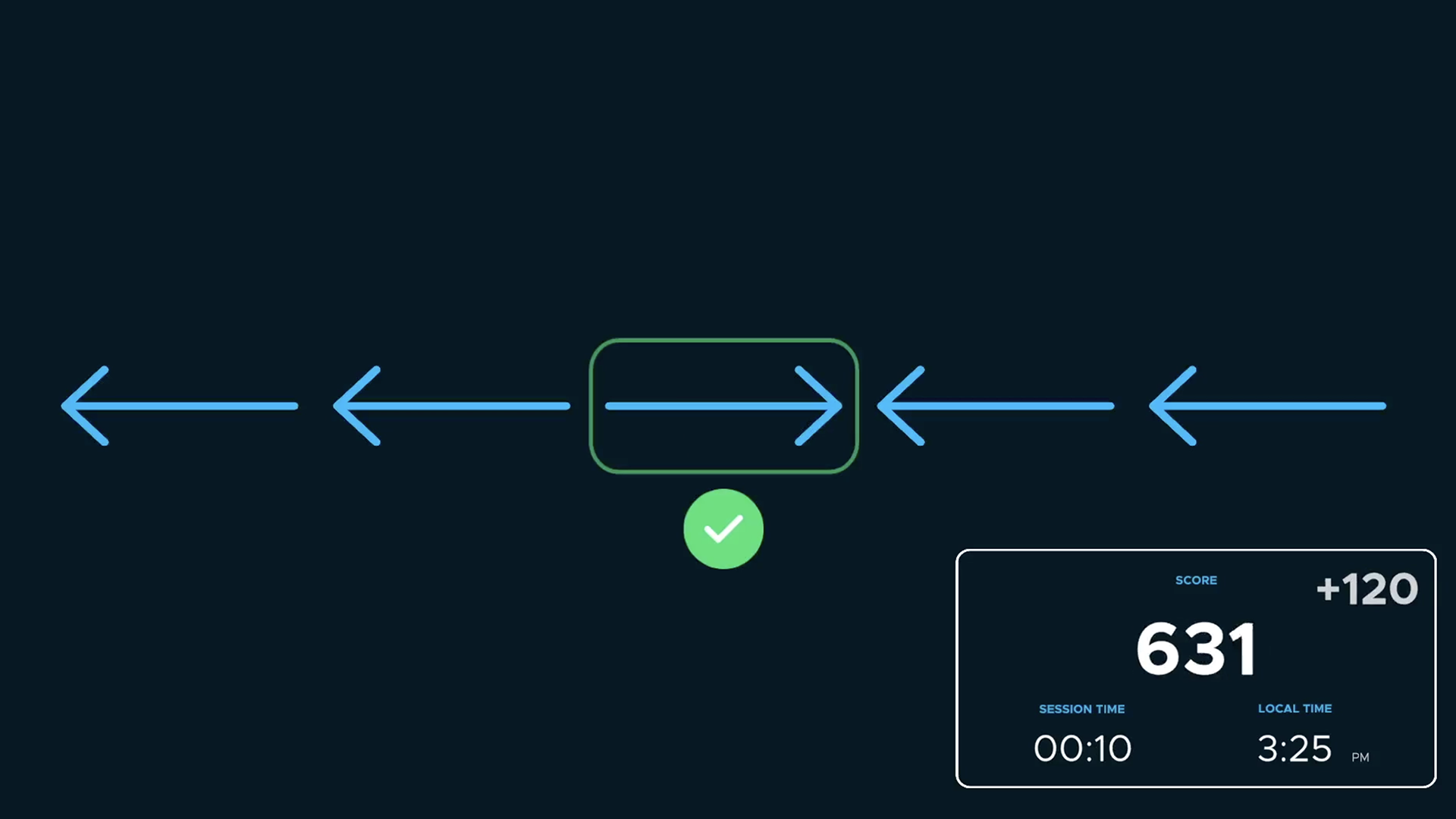
aspects of attention and executive functions. In this game the user is presented with
different arrows aligned horizontally. He/She is asked to respond to the central target
stimulus (e.g., the central arrow) flanked by distractor stimuli (e.g., the other arrows) on
either side. The user is asked to respond to the direction in which the central arrow is
pointing, while ignoring the flanking distractors.
There are two main types of flanker tasks. In a Congruent Flanker Task, the central arrow
points the same direction as all the other arrows. For example, if the central arrow is
pointing to the right, the flanking arrows also point to the right. In an Incongruent Flanker
Task, the central arrow points at the opposite direction from the other arrows. For
example, if the central arrow is pointing to the right, the flanking arrows point to the left.
The key measure in a flanker task is the participant'
s reaction time and accuracy in
responding to the central target while
ignoring the distracting flankers. This task is used to assess a person
'
s ability to focus
attention, inhibit irrelevant information,
and maintain cognitive control in the presence of conflicting stimuli.

Assessment Gamelet
How to Play
Upright:
To respond to direction (any of these options):
Steer handlebar in the correct direction
Push trigger on the correct side
Push bumper on the correct side
08Recumbent:
To respond to direction (any of these options):
Move handlebar of the correct side (up or down, both work)
Push top button on the correct side
Why Does It Matter?
Assessment of Cognitive Control: The flanker task is designed to measure cognitive
control, specifically the ability to inhibit irrelevant information and maintain focus on
a specific task. Inhibitory control is a fundamental aspect of executive function, which
is crucial for goal-directed behavior and daily functioning.
Assessment of Attention Processes/Selective attention: It provides insights into
selective attention; the ability to prioritize and attend to relevant information while
filtering out distractions. This is important for tasks that require concentration and the
ability to ignore interferences.
Research Tool: In research settings, the flanker task is used to investigate various
cognitive processes, including response inhibition, conflict resolution, and the impact
of distractors on performance.
Clinical Assessment: In clinical psychology and neuropsychology, the flanker task is
used to assess cognitive deficits or impairments related to attention. For example, it
can help diagnose conditions like attention deficit hyperactivity disorder (ADHD),
which is characterized by difficulties in attention and impulse control.
Scoring System
Points per Brain Skills
Reflex score: In the scoring system, a total of 100 points is allocated, with 100%
dedicated to Average Visual Reaction Time. In the game, the decision to respond is
based entirely on visual cues, as it involves understanding which direction the central
arrow shows. This is why the visual aspect is weighted so heavily. Additionally, the
control mechanism in this game is designed so that the moment you move the
handlebar and responds to stimuli, it coincides with the end of the round, so it is not
possible to measure any other reaction times.
Targeted Brain Skills